Spanish Father Takes Religious Freedom Fight to European Court After Being Stopped From Sharing His Faith With His Son.
An ongoing religious-freedom dispute which involves a Spanish father and his younger son has reached the entrance of the European Court of Human Rights, raising questions about how concerns the state can intervene when divorced parents disagree over a child’s religious upbringing.
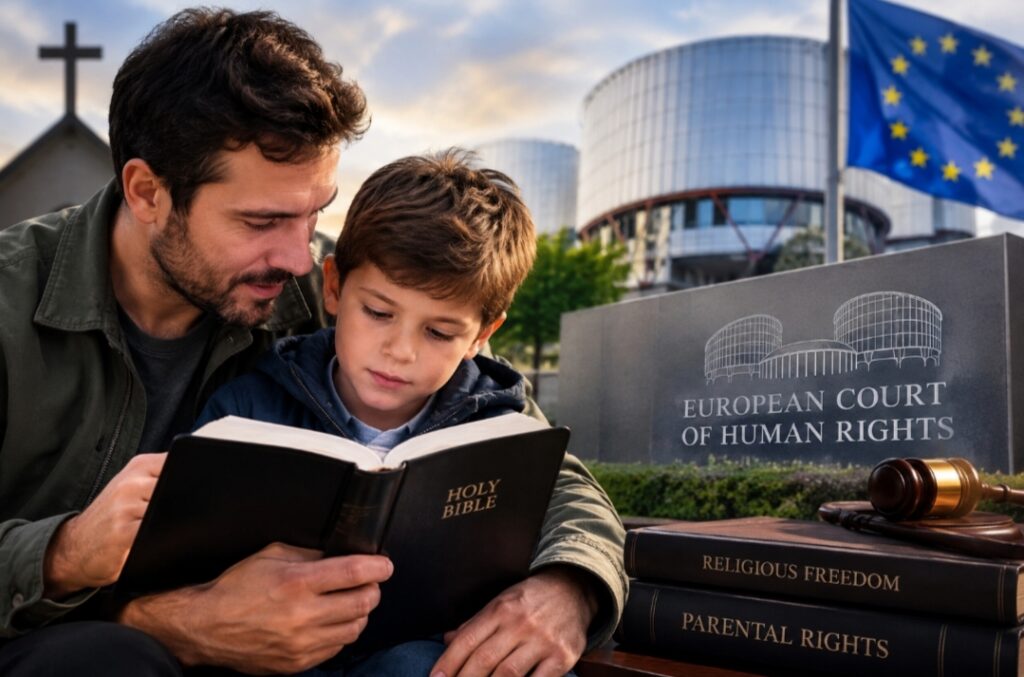
The said case, M.J.B.D. v. Spain, involves two divorced partners, a father who took his son to an evangelical church, showed him Bible passages on a tablet and shared aspects of his Christian faith with him. On the other hand, the child’s mother objected to it and further brought the disagreement before a Spanish court in 2022. The child was born in 2016.
A sitting court in Alcobendas subsequently gave the mother an exclusive authority over decisions concerning the child’s religious formation until he reached the age of 12-years. The order follows as it specifically prohibited the father from taking the boy to the evangelical church, showing him biblical passages on the tablet or in anyway instructing him in the evangelical faith.
The Madrid Provincial Court, according to the update later upheld the decision.The Spanish courts state it reasons that, the parents had previously raised their son without affiliating him to a particular religion and had further agreed that the child would receive values-based rather than religious education. The courts therefore considered the parents to maintain that arrangement until the child was sufficiently mature enough to make his own religious decisions.
The father challenged the ruling before Spain’s Constitutional Court, arguing that the restrictions interfered with his freedom of religion and his right to have his child receive religious and moral education consistent with his convictions.
Around May 2025, Spain’s Constitutional Court rejected his appeal. The court then stated that, the restrictions did not prevent the father from practicing his own belief religion. Instead, they temporarily limited his ability to involve the child in any evangelical religious activities while the disagreement between the parents remained unresolved.
The Constitutional Court also considered the child’s own freedom of religion and developing ability to make religious decisions. Its ruling emphasized that the restrictions were temporary and that the child could later make his own religious choices once he reached sufficient maturity.
The dispute has been currently moved to Strasbourg. The European Court of Human Rights records that the father’s appeal application was lodged on September 19, 2025, and communicated to Spain on June 11, 2026. The case still remains pending; the European court has not issued a final judgment on the complaint.
The case also touches on earlier European human-rights jurisprudence concerning parents and religious education, including the 2022 T.C. v. Italy judgment that was considered by Spain’s Constitutional Court.
While the court case continues, the Federation of Evangelical Religious Entities of Spain (FEREDE) has sought permission to participate as an amicus curiae, meaning that a third party that can provide the court with information, evidence or legal context. FEREDE says the ongoing case raises broader questions about religious freedom and the extent to which the state can intervene in the private and family sphere.
The Strasbourg proceedings could therefore attract attention beyond this particular family. At their center are competing considerations involving a parent’s religious freedom, the child’s developing religious autonomy, the rights and responsibilities of parents, and the role of courts when separated parents cannot agree.
For Christian families following the case, the proceedings have become a significant point of interest in the wider discussion about religious freedom and raising children in the faith. A final decision from the European Court of Human Rights could provide further guidance on how these competing rights should be considered under European human-rights law.